
The relationship is the work.
Finding the right fit is the most important part of therapy — and harder than it seems.
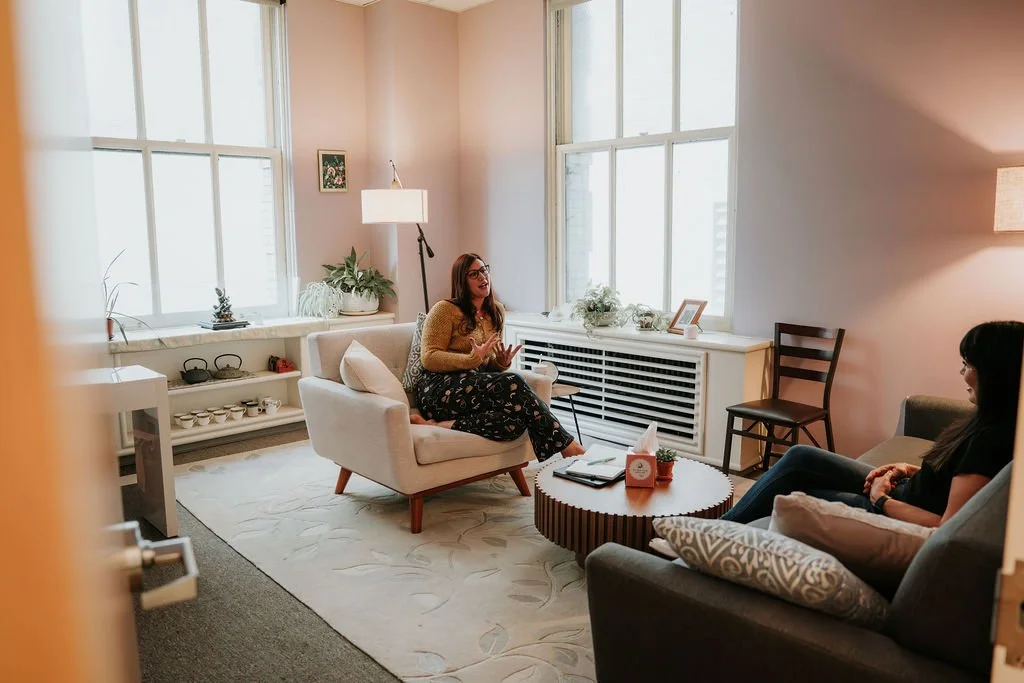
You’re in the right place if…
You want to understand how you work, not just manage symptoms. You know there are better ways of moving through the world and you want to find them.
You have the sense that some of what you're carrying isn't only yours. Some of it has been handed to you through the generations. Some of it is built into the world we are embedded in.
Together, we can untangle the knots in your mind to create a life that is alive and true.
→ You're ready to do more than manage symptoms
→ You're (mostly) ready to face yourself, with someone walking beside you
→ You're smarter than you give yourself credit for — and need help getting out of your own way
→ You sense that some of what you're carrying isn't only yours
The actual work
Calming your nervous system
Learning to regulate, work effectively with your brain, and take care of your body — filling in the gaps of what you already know about tending to yourself. You aren't failing: your nervous system is responding as designed.
Getting curious and kind
When you can be present for your entire experience — not just the comfortable bits — you can change patterns, create relationships that actually nourish you, and find a sturdy internal safety that doesn't depend on external circumstances.
Excavating patterns
A space to notice what you've internalized, where it came from, and what it could mean to be more free. We are all being asked to wake up right now — to the patterns playing out in the world and in ourselves.
A FICTIONAL CLIENT
JordanWHAT THE WORK ACTUALLY LOOKS LIKE
Jordan came to me to address OCD symptoms at work. We started by mapping intrusive thoughts, when they peaked, and how to exit the loop of fears and compulsions; simply talking about the thoughts as parts of her rather than realities to fight, Jordan found some relief.
Over time, we noticed how OCD intersected with uncertainty in Jordan's relationships. We moved into exploring identity, boundaries, and authenticity - eventually Jordan came out as queer and embraced previously undiagnosed ADHD. They came to understand intrusive thoughts as signals that they felt insecure and lonely.
Jordan started with real skills to regulate and then moved into deeper work from there.
Sooo, what kind of therapist are you?
I call myself a depth-oriented ACT therapist. I am deeply trained in ACT and DBT, while also learning from more psychodynamic mentors. This means I track the relationships between your inner world (thoughts, emotions, sensations, memories) and your outer world (actions, history, broader context).
This might look like changing how you relate to your thoughts and emotions - like discerning when to follow an internal cue versus simply noticing a passing emotion or thought without getting hijacked. Or it might look like changing your relationships and behaviors.
Deeply trained in:
Learning from mentors who taught me how to be focused, strategic, and goal-oriented while present, alive, and attuned.

I don’t want to be in therapy forever…
A client and I once compared therapy to firefighting: you might start in crisis mode and we focus on a problem strategically. Then the smoke clears and the work shifts to something akin to forest management in which we work to clear underbrush to prevent future devastation.
I tend to work with people long-term, with the focus and goals evolving over time. Whether we work together for a concentrated period of time or I accompany you through various seasons of life, I feel honored to walk beside you through both the dark parts of life and light ones.

We need each other
More than ever, we need community and spaces that are therapeutic - places offering community, reflection, and ritual. Therapy is one part of that as a co-created space where you learn to approach yourself with curiosity and kindness, figure out what you actually need, and develop an internal steadiness that exists even when the outside world is in chaos.

The practical stuff
I offer in person sessions in downtown Oakland and the FiDi in SF, and via telehealth anywhere in California and New York. Sessions are about 50 minutes.
My fee is $250. I do offer sliding scale spots — if fee is a barrier, just mention it when you reach out and we'll figure out what's workable.